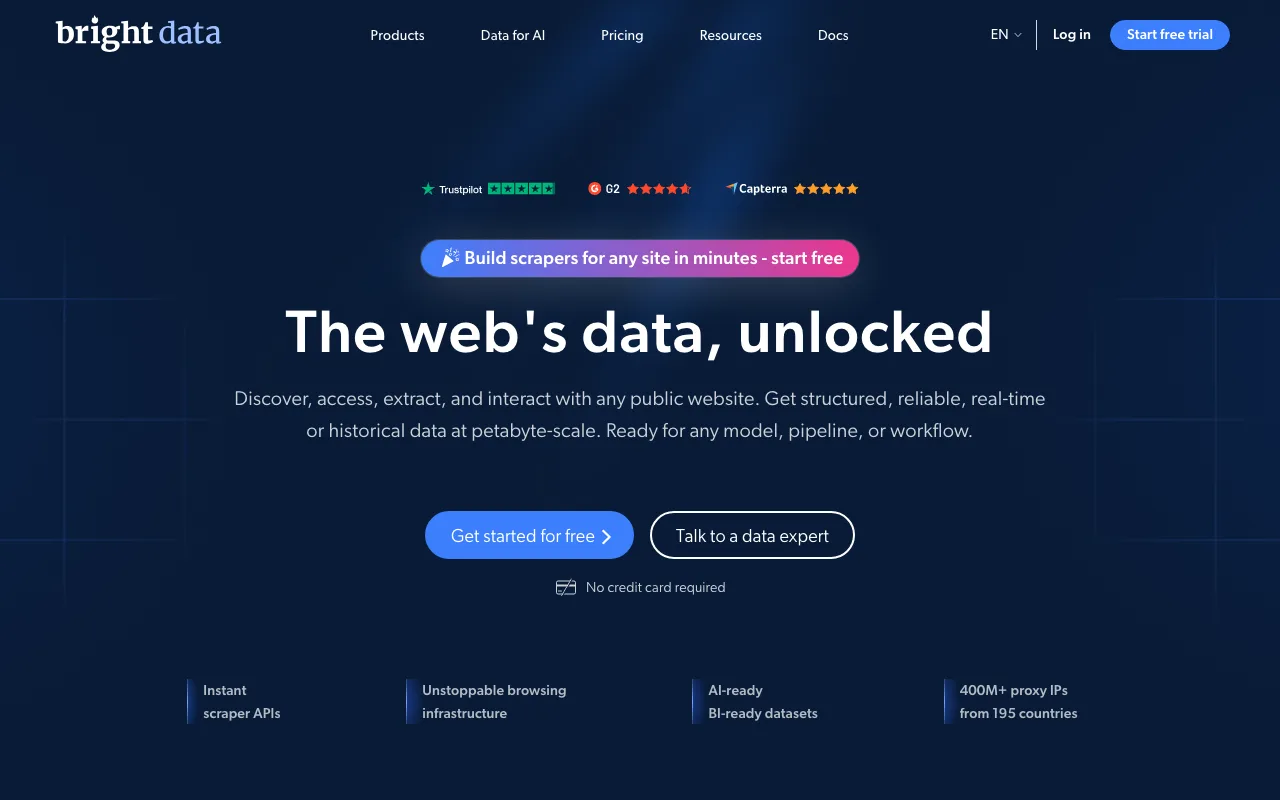
Bright Data Review
Bright Data is the reference implementation of a commercial proxy network: biggest pool, best targeting, best unblocking tools, highest price. If a target is genuinely hard, this is what works.
Review last updated 2026-08-20 · How we rate providers
Scorecard
Pros
- The largest and most reliable proxy pool in the industry, by a wide margin
- Targeting down to city, ZIP and ASN, with carrier selection on mobile
- Web Unlocker and Scraping Browser genuinely solve hard anti-bot problems
- Serious compliance function: customer KYC, use-case review and a published policy
- Dashboard, logs and API tooling that enterprise teams can actually operate
Cons
- The most expensive network in the category at entry volumes
- Sister company of Hola VPN, whose free users originally supplied the pool
- Pricing model is complex, with per-GB, per-IP and per-request lines
- Sales-led onboarding for anything beyond pay as you go
Privacy, jurisdiction & audits
Who the company answers to legally, what it keeps, and whether anyone independent has checked.
| Legal jurisdiction | Israel outside 5/9/14 EyesFormerly Luminati Networks; sister company of Hola VPN, whose users originally supplied the residential pool. |
|---|---|
| Logging policy | Not a privacy service; operational logs by design |
| Independent audits | Deloitte, 2024 SOC 2 Type II and privacy compliance program |
| Anonymous payment | Card / PayPal only |
| How IPs are sourced | Opt-in SDK partnerships and a paid contributor program, with a compliance team, KYC on customers and a published usage policy. |
Bright Data plans & pricing
Advertised rates as of August 20, 2026. VPN promo rates normally require the prepaid term shown and renew at the higher rate; proxy pricing falls with volume. Confirm on Bright Data's own site before buying.
| Plan | Price | Min spend | Notes |
|---|---|---|---|
| Residential (pay as you go)Residential Proxies | $8/GBno commitment | Free | Falls to roughly $2.50-5/GB on monthly commitments |
| ISP staticStatic ISP Proxies | $12.50/GBno commitment | Free | Also sold per IP on committed plans |
| DatacenterDatacenter Proxies | $0.90/IP/momonthly per IP | Free | Plus a small per-GB traffic charge on some plans |
| MobileMobile Proxies | $8.40/GBno commitment | Free | |
| Web UnlockerScraping APIs | $1.50/1k requestspay as you go | Free | Handles blocks, CAPTCHAs and retries; billed per successful request |
Features
Our Bright Data review
Bright Data operates the largest residential proxy pool on the market, with over a hundred million addresses, plus ISP, datacenter and mobile networks and a set of managed scraping products layered on top. For any serious data-collection operation it is the benchmark everything else is measured against.
The targeting is the technical differentiator. Country, state, city, ZIP code, ASN and mobile carrier, with sticky sessions up to thirty minutes and per-request rotation. Combined with the pool size, that means you can consistently get a fresh residential IP from a specific American suburb, which is exactly what price monitoring and ad verification need.
Web Unlocker deserves attention because it changes the economics. Rather than buying proxies and building your own retry, CAPTCHA and fingerprint logic, you send a URL and pay per successful response. On protected targets that is often cheaper in engineering time than doing it yourself, even at $1.50 per thousand requests.
The uncomfortable history is Hola. Bright Data was founded as Luminati and built its early residential pool from Hola VPN's free users, whose bandwidth was resold without most of them understanding it. The company has since built an extensive compliance program, with consent flows, a paid contributor scheme, customer KYC and use-case review, and it has won court cases against scraping-related claims. It is a materially different operation than it was a decade ago, but the origin is part of the record.
Costs are high at the entry level. Residential pay as you go is around $8 per gigabyte, roughly double what mid-market rivals charge, falling toward $2.50 to $5 on commitments. For small projects that gap is decisive; at enterprise volume, the reliability usually justifies it.
Buy Bright Data when success rate on defended targets is what you are paying for. Buy Decodo, IPRoyal or Webshare when the targets are easy and price dominates.
Notable facts
- Founded as Luminati Networks; sister company of Hola VPN
- Residential pool exceeds 100 million addresses
- Runs customer KYC and use-case review before granting access
At a glance
| Founded | 2014 |
|---|---|
| Headquarters | Netanya, Israel |
| Service types | Residential Proxies, Static ISP Proxies, Datacenter Proxies, Mobile Proxies, Scraping APIs |
| IP pool | 150M addresses |
| Country coverage | 195 |
| Proxy protocols | HTTP(S), SOCKS5 |
| Rotation | Per request, or sticky sessions up to 30 minutes |
| Starting price | $8/GB |
| Free trial | 7 days |
| Free tier | No |
| Support | chat, email, tickets (24/7), account manager on larger plans |
Frequently asked questions
Why is Bright Data more expensive than other proxies?
Pool size, targeting granularity and success rate on defended sites. On easy targets the premium buys little; on protected ones cheaper networks fail often enough that the effective cost per successful request can be higher.
Where do Bright Data residential IPs come from?
From opt-in SDK partnerships with app developers and a paid contributor program. The early pool came from Hola VPN users, which is why the company's consent and compliance program is now unusually elaborate.
What is Web Unlocker?
A managed endpoint that handles proxy selection, browser fingerprinting, CAPTCHA solving and retries, billing per successful request instead of per gigabyte.
Bottom line
Bright Data is the reference implementation of a commercial proxy network: biggest pool, best targeting, best unblocking tools, highest price. If a target is genuinely hard, this is what works.
Check current Bright Data pricing →